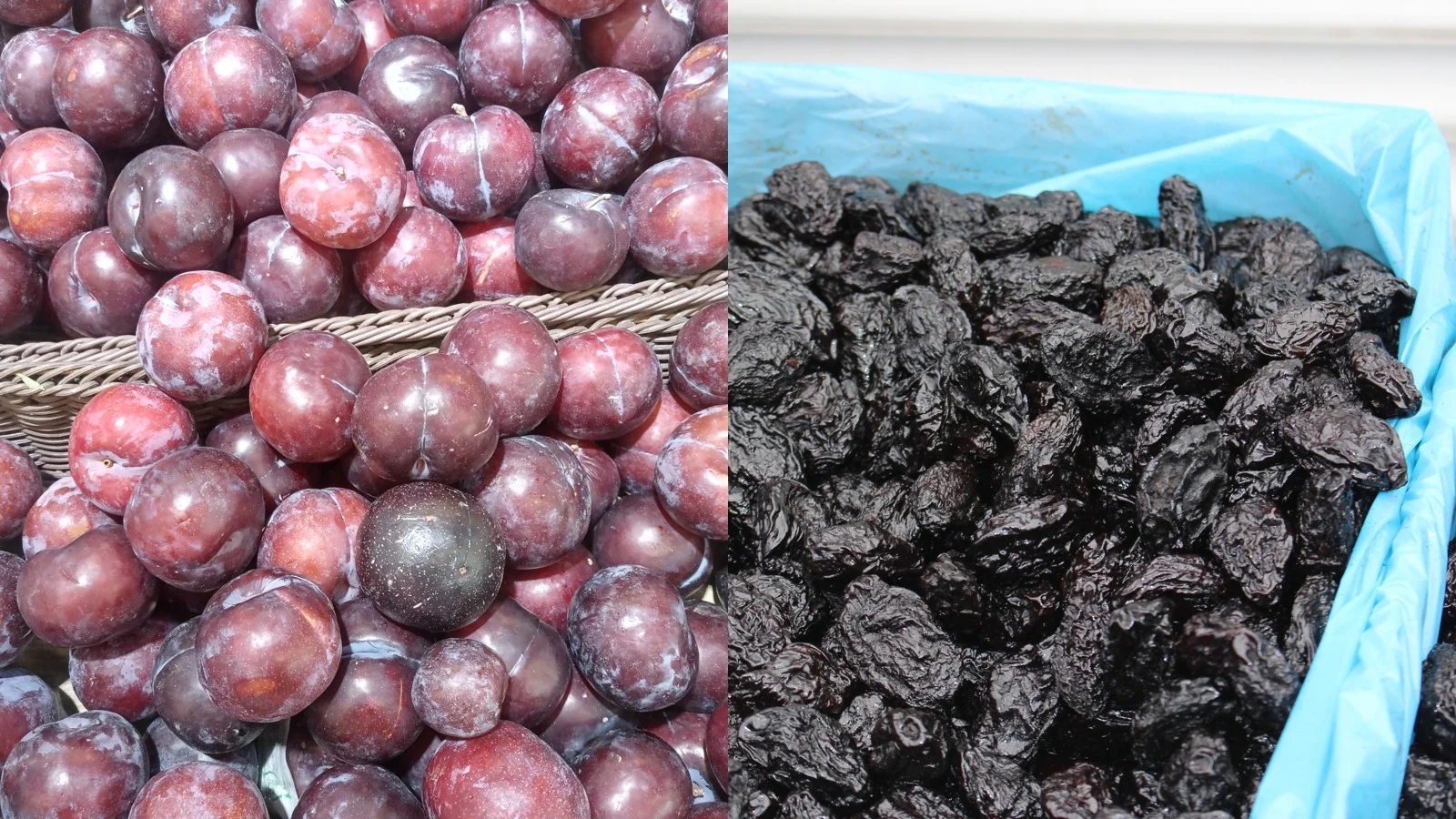
The same fruit family, different export markets
Uzbekistan’s fresh and dried plum exports serve markedly different groups of immediate buyers. Russia bought 61.1% of fresh-plum export value in 2024, while China bought 50.1% of prune export value. The difference is not simply that one product relies on a large market and the other does not: both have concentrated sales, but their leading markets are different.
This report compares fresh plums and sloes under HS 080940 with dried prunes under HS 081320. It uses the two published product reports and their datasets, with 2024 as the main comparison year and 2020–2024 as the common annual period. It describes recorded trade patterns rather than explaining why particular exporters chose particular markets.
Prunes led earnings, fresh plums led shipped weight
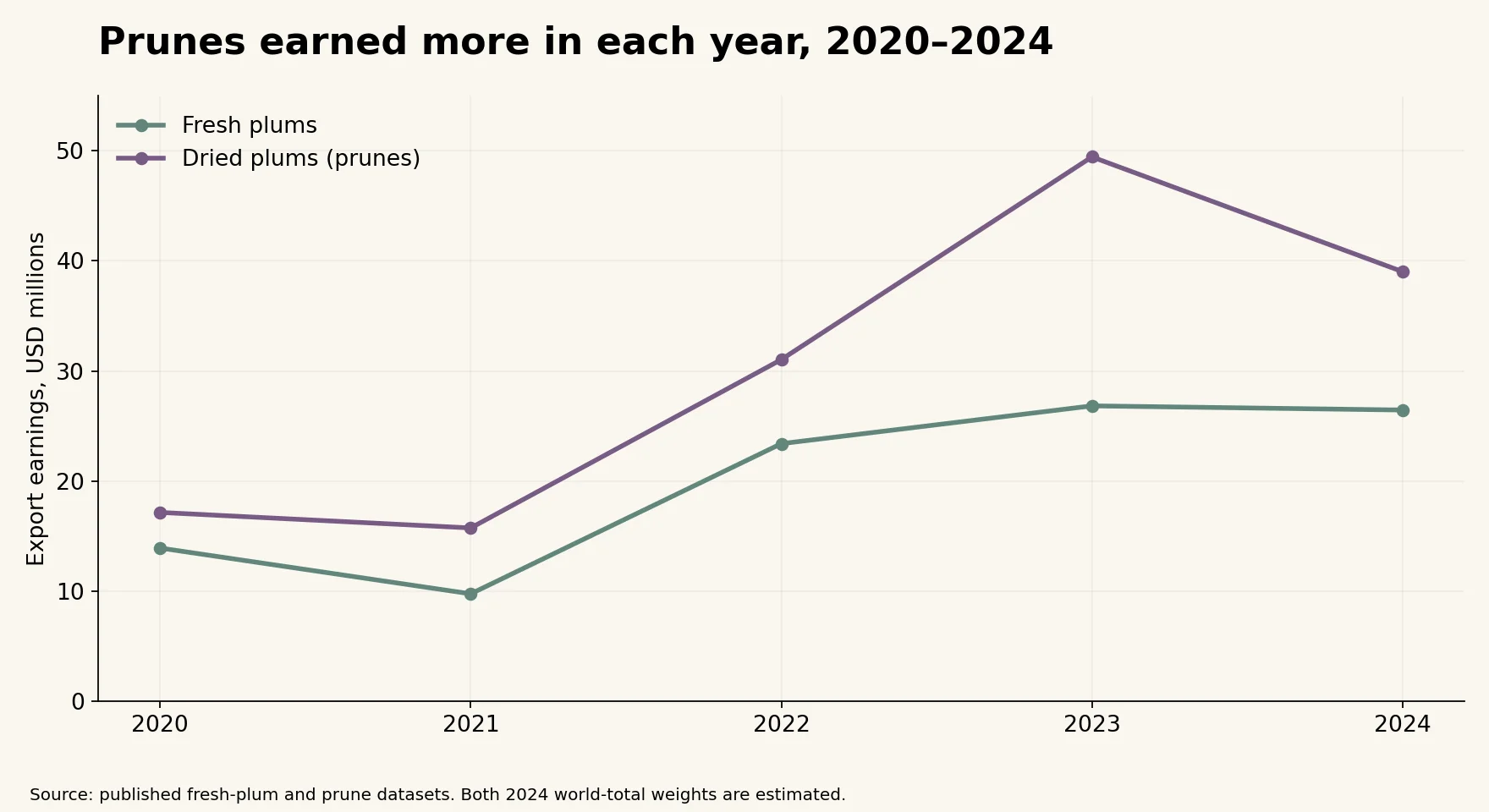
Prune exports generated $39.0 million in 2024, compared with $26.4 million for fresh plums. Together, the two categories earned approximately $65.5 million. Prunes accounted for 59.6% of that combined value. The combined figure covers these two customs categories, not all Uzbek fruit exports.
Prunes earned more than fresh plums in every year of the common 2020–2024 series. Both categories expanded after 2021, but the prune earnings increase was larger before the retreat from its 2023 peak.
!Fresh and dried plum export earnings
The weight ranking was reversed in 2024. Fresh plums recorded approximately 33,013 tonnes, against 27,662 tonnes for prunes. Aggregate unit values were about $0.80 per kilogram for fresh plums and $1.41 for prunes. A lower shipped weight can therefore accompany higher recorded earnings.
However, fresh and dried kilograms are not equivalent inputs. Drying removes moisture, and the two export categories may differ in variety, quality, processing and packaging. The figures do not show that a kilogram of harvested plums would earn more if dried, or that either category is more profitable. That comparison would require conversion yields, rejected fruit, processing expenses and delivery costs.
Fresh fruit relied on Russia and Kazakhstan
Russia purchased $16.2 million of fresh plums in 2024, while Kazakhstan bought $8.9 million. Their combined share was 94.7%. Kyrgyzstan accounted for another 4.6%, leaving less than 1% for all remaining destinations.
The leading pair for prunes was China and Russia. China purchased $19.5 million and Russia $11.7 million, together accounting for 80.0%. Belarus, Türkiye and Kazakhstan were the next largest buyers, with substantially smaller values.
!Destination shares for fresh plums and prunes
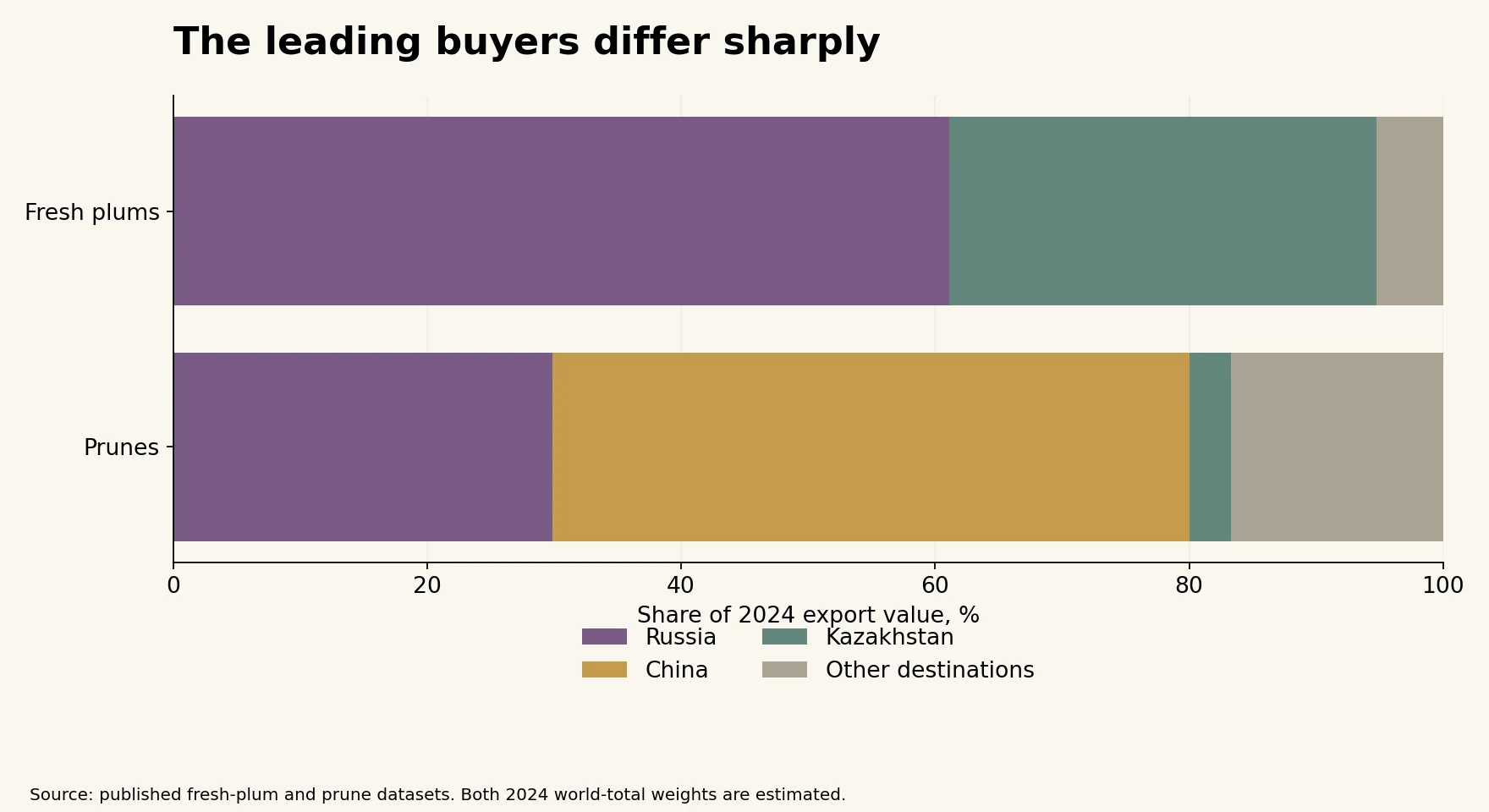
On the combined share of each product’s two largest destinations, fresh-plum earnings were more concentrated than prune earnings in 2024. This is a specific concentration measure, not a complete ranking of commercial risk. Prunes still depended heavily on two markets, and China alone represented just over half of their value.
The fresh-plum destination file contains 13 positive-value partners for 2024; the prune file contains 32. A larger number of destinations does not automatically mean balanced sales. Small shipments can add entries to a destination table without materially reducing exposure to the leading buyers.
Destination records identify immediate partners, not necessarily final consumers. They do not establish subsequent re-exports, the number of importing firms or the reasons behind the different buyer mix. The data do not support a claim that drying itself caused access to China.
Both contracted, but earnings moved differently
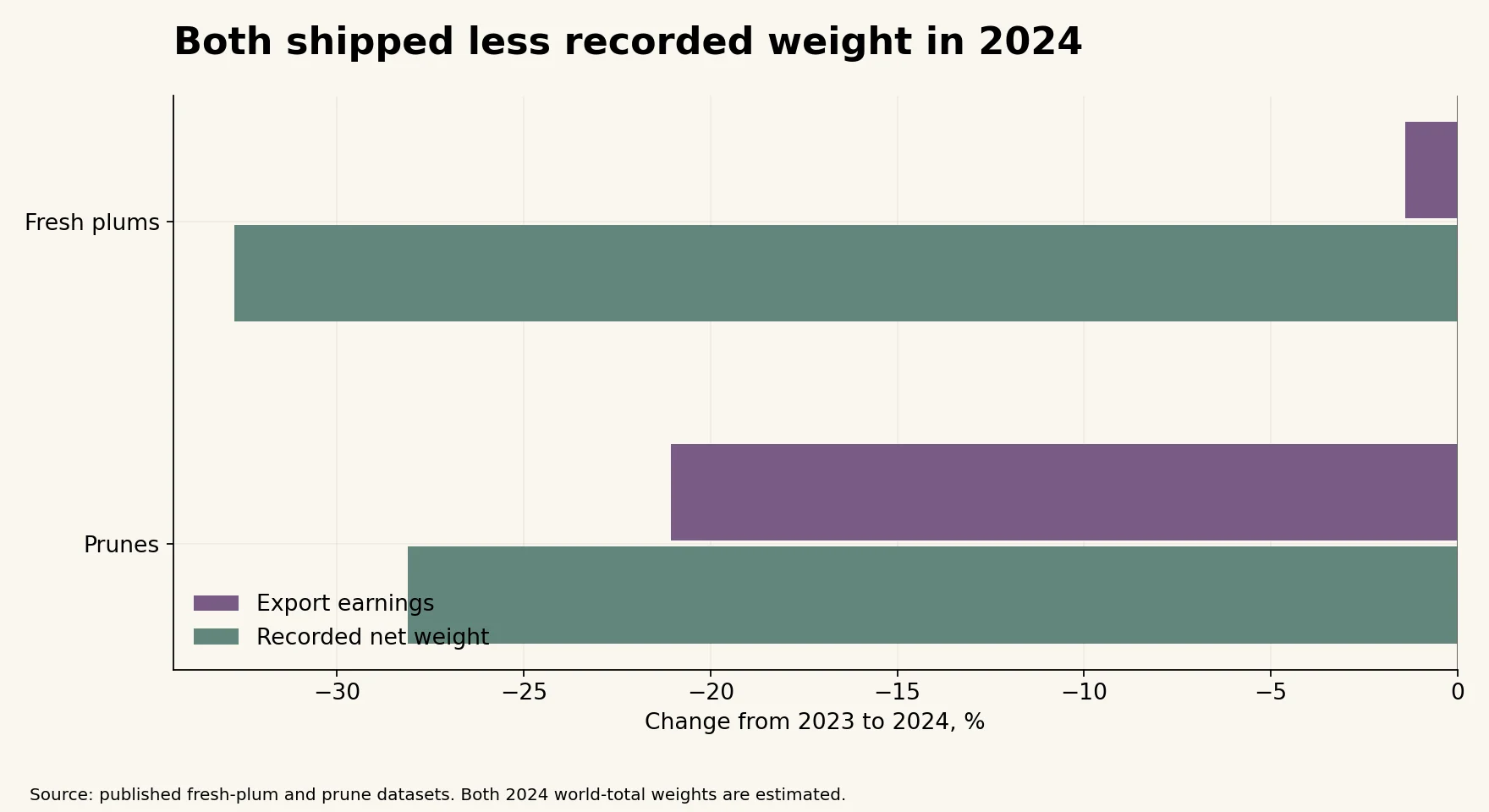
From 2023 to 2024, fresh-plum earnings declined only 1.4%, while prune earnings fell 21.1%. Recorded weight fell in both categories: 32.8% for fresh plums and 28.1% for prunes.
The associated unit-value increases were approximately 46.6% for fresh plums and 9.8% for prunes. The larger fresh-plum increase cushioned its recorded weight decline more strongly. This is an accounting description: earnings equal weight multiplied by unit value. It does not prove that every shipment received a higher price or that profit margins improved.
!Changes in earnings and recorded net weight
Both 2024 world-total weights are flagged as estimated by UN Comtrade. The 2023 prune world weight is not flagged, while the earlier fresh-plum WITS tables used by this project do not expose estimation flags. Weight changes and the ratios derived from them should be interpreted with these limitations.
Destination comparisons across years need care too. The 2023 fresh-plum table includes $4.5 million assigned to an unspecified destination, and the prune table includes $1.0 million. Those entries remain in their respective world totals. They cannot be allocated to a named buyer without additional evidence.
Different exposures, no simple winner
Fresh plums combined a smaller earnings decline with greater concentration in their two largest destinations. Prunes earned more and reached more recorded partners, while showing a larger contraction and a strong reliance on China. Neither set of results establishes an overall commercial winner.
For fresh plums, a useful next question is whether shipments can recover while additional markets become meaningful. For prunes, it is whether sales outside China and Russia recover alongside total earnings. Answering why these outcomes change requires evidence on contracts, shipment timing, product specifications and costs beyond the annual totals used here.
Sources and method
The comparison reuses the four published datasets linked below; no duplicate product profiles or source datasets are created. Fresh-plum annual records cover 2020–2024 and destinations cover 2024. Prune annual and destination records cover 2020–2024.
Fresh-plum annual figures for 2020–2023 come from World Bank WITS at displayed precision, with the monetary values converted from thousands of USD to USD. The 2024 fresh-plum records and all prune records come directly from UN Comtrade. Both sources report Uzbekistan’s exports for the product codes stated above.
Shares divide destination value by the same product’s world total. The leading-pair comparison uses Russia and Kazakhstan for fresh plums and China and Russia for prunes. Changes compare 2024 with 2023; unit values divide export USD by net kilograms. Tonnes equal kilograms divided by 1,000. Values are current dollars, and the analysis does not adjust for inflation or deduct costs.
Data checked October 18, 2026. September 15 is the series date.
Cover photograph
Photo montage: Fumikas Sagisavas, Black plums, CC0; and Emőke Dénes, Dried Prunus domestica, CC BY-SA 4.0. The cropped photo montage is licensed CC BY-SA 4.0. Cropped for the cover format. Illustrative photograph; it does not document a shipment or farm in Uzbekistan.

