What drove the 2024 increase?
Uzbekistan’s exports of fresh peaches and nectarines reached $96.9 million in 2024, up 35.1% from $71.7 million in 2023. Unlike a recovery driven only by a higher average value per kilogram, this increase combined more recorded shipped weight with a higher aggregate unit value.
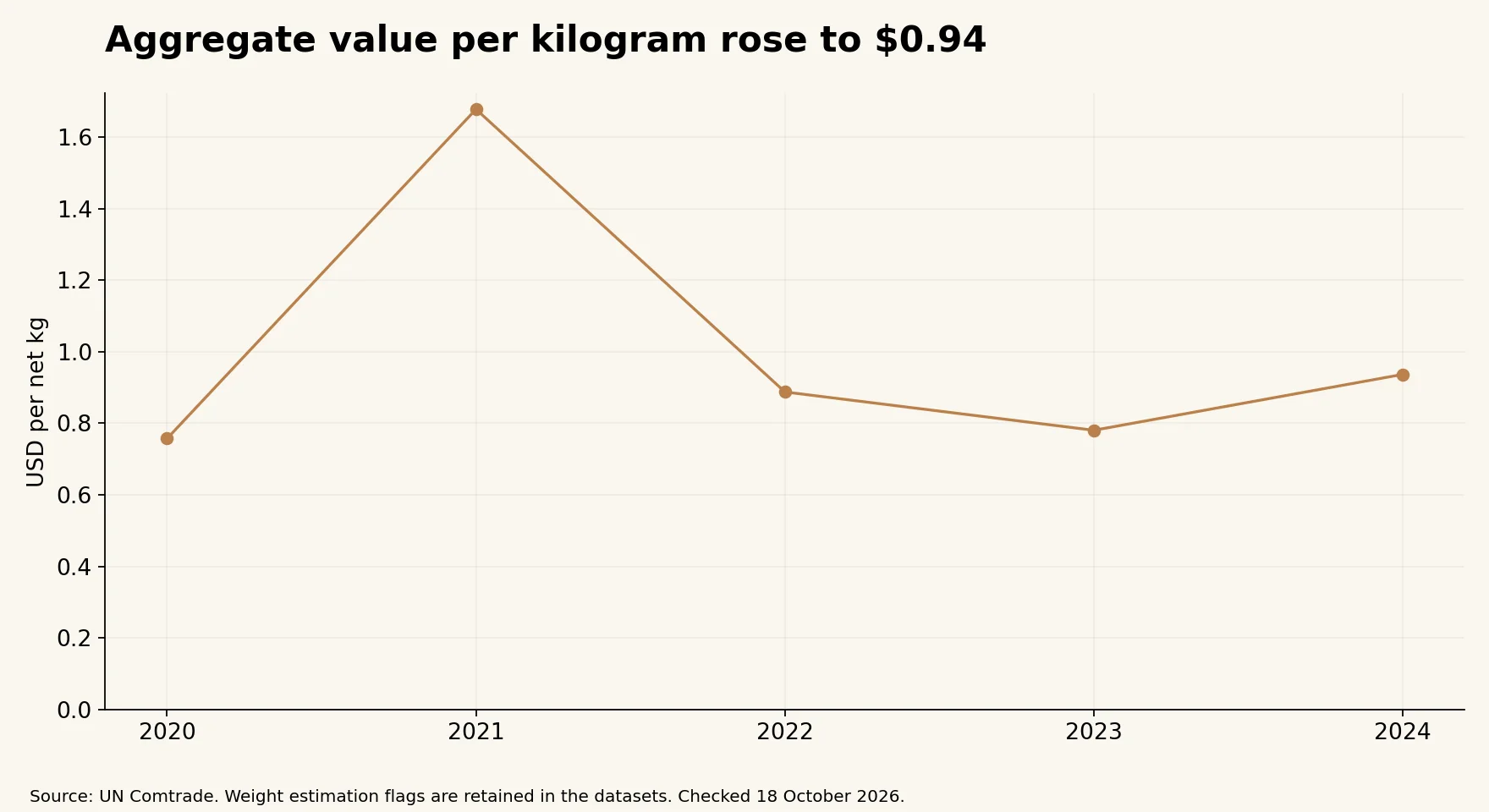
Recorded net weight rose from approximately 91,881 tonnes to 103,463 tonnes, an increase of 12.6%. Aggregate export value per kilogram rose from $0.78 to $0.94, or 20.0%. Both sides of the earnings calculation therefore moved upward.
The customs category is HS 080930, covering fresh peaches including nectarines. The data do not separate the two fruits, so this report cannot attribute growth to peaches or nectarines individually. Dried peaches and other stone fruit are excluded.
!Annual peach earnings and recorded weight
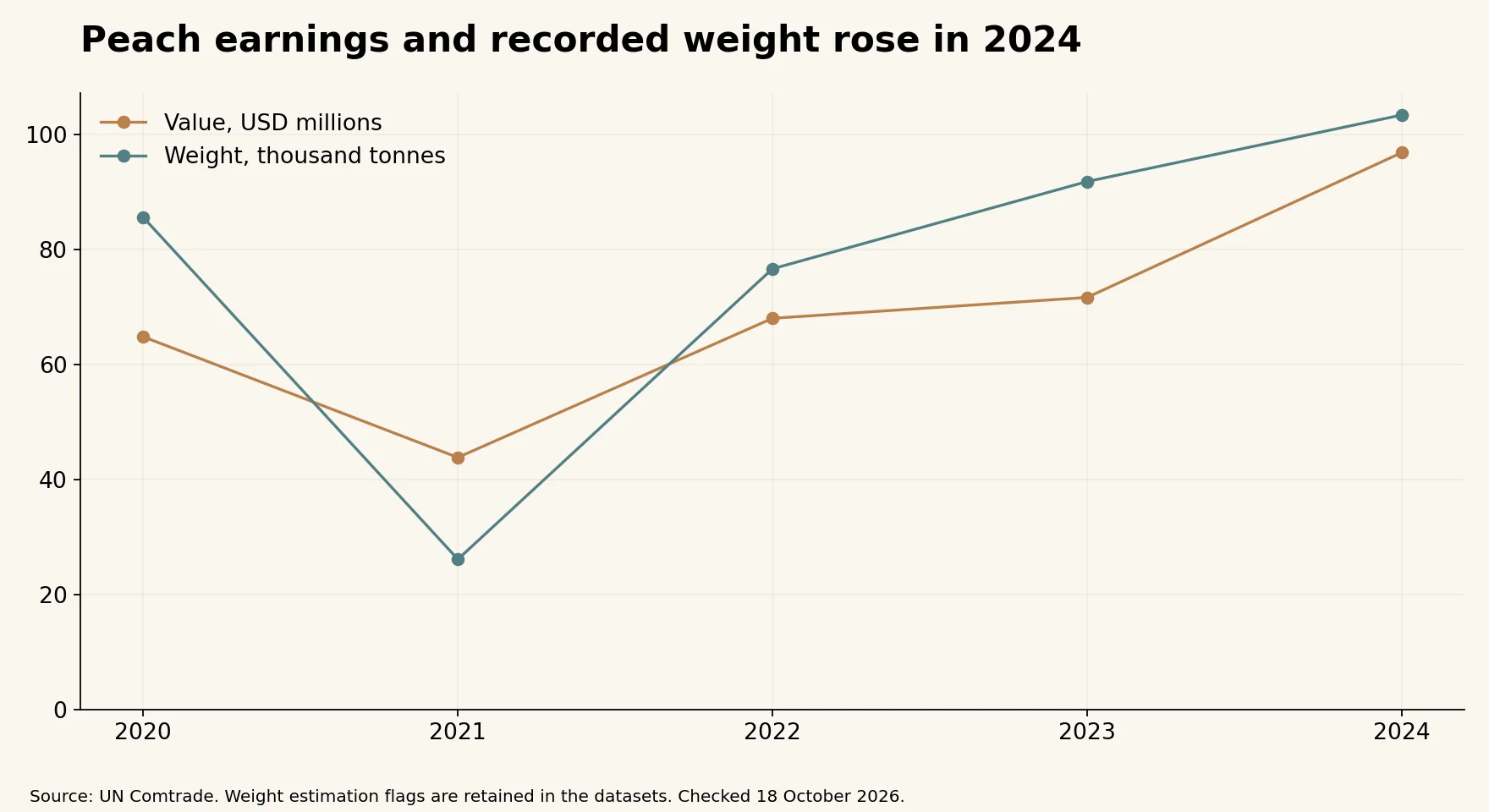
The chart labels its two units separately: USD millions and thousand tonnes. Their numerical positions are not equivalent measures.
Two factors contributed to earnings growth
Export earnings equal recorded weight multiplied by aggregate unit value. Multiplying the 2024 weight-growth factor by the unit-value-growth factor gives the overall earnings-growth factor: approximately 1.126 × 1.200 = 1.351.
The 12.6% and 20.0% increases do not simply add to 35.1%, because the higher unit value also applies to the additional recorded weight. The interaction between the two factors accounts for the difference. This is an accounting identity rather than a causal explanation of trade growth.
The longer series provides context. Earnings were $64.9 million in 2020, fell to $43.9 million in 2021, and recovered to $68.1 million in 2022. The 2024 total was the largest in the five-year period. Recorded weight also exceeded the earlier annual observations in this series.
!Aggregate peach export unit values
Growth remained concentrated in one market
Russia bought $80.0 million of Uzbekistan’s peach and nectarine exports in 2024, accounting for 82.5% of total value. Kazakhstan followed with $11.7 million, or 12.0%, and Kyrgyzstan with $4.9 million, or 5.0%. Together, these three buyers accounted for approximately 99.6% of earnings.
The 2024 destination list contains 15 positive-value partners. The additional entries include Belarus, Turkmenistan and the United Arab Emirates, but their values were small relative to the leading markets. Counting destinations alone would therefore give an incomplete picture of market exposure.
!Peach export destination values
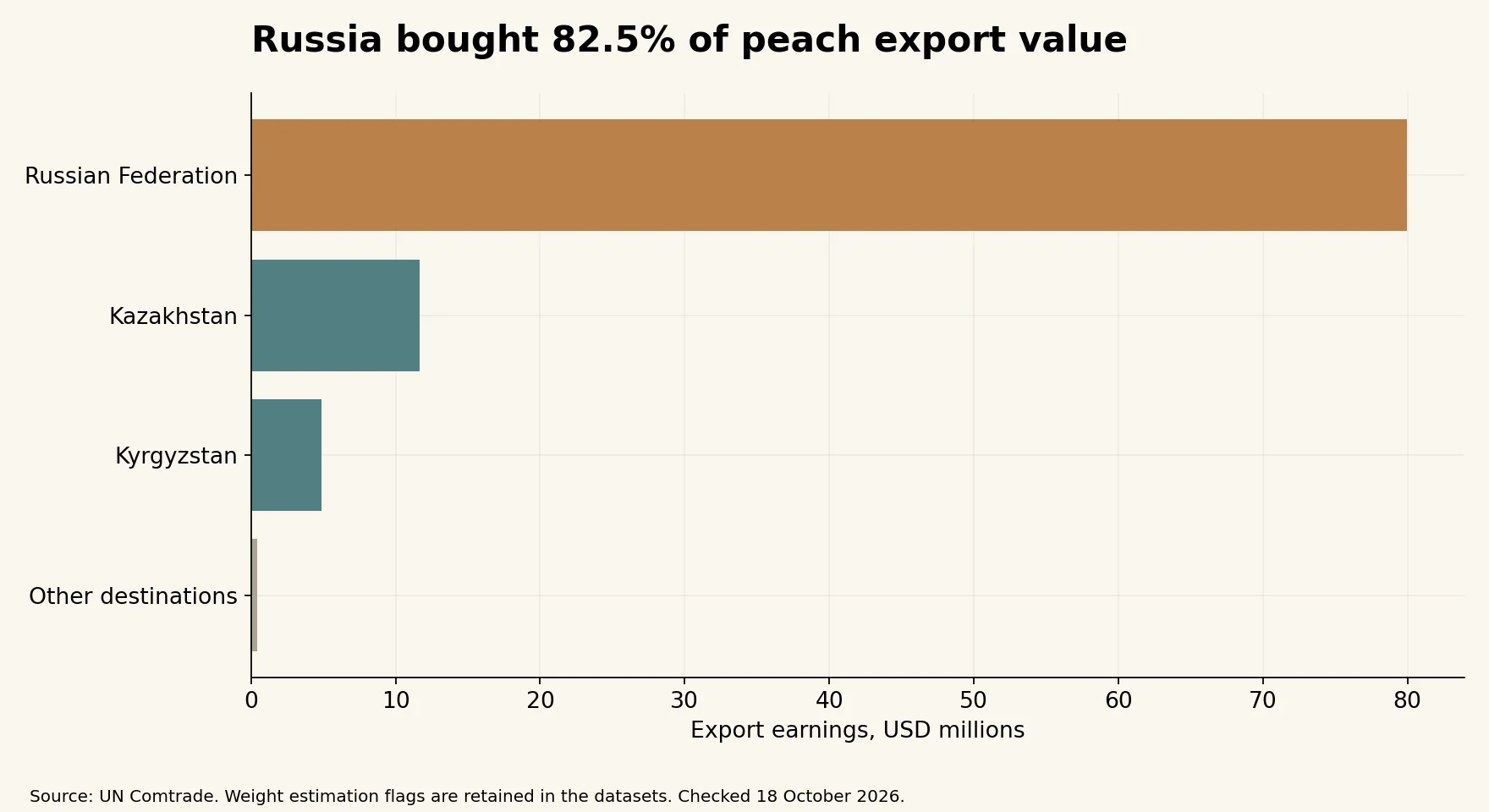
High reliance on one immediate destination means a large share of recorded receipts is associated with that market. It does not establish the number of importing firms or the ultimate consumers. Shipments may be re-exported, and the annual totals cannot identify contract terms, shipment timing or the reasons behind buyer choices.
The growth question and the concentration question should be kept separate. Strong earnings growth can coexist with a narrow destination base. The 2024 records demonstrate that combination without showing that concentration caused or prevented growth.
What the ratios cannot establish
UN Comtrade flags the world-total net weights in all five years as estimated. This limitation applies directly to the volume-growth and unit-value calculations. The ratios describe the available trade records; they should not be presented as precise measurements of physical shipments independently verified by this project.
Unit value is total export value divided by net weight. Changes in grade, variety, destination, packaging and shipment timing can affect it. An increase does not prove that every exporter raised prices, that product quality improved or that farmers earned higher profits.
Production and delivery costs are absent from these datasets. They cannot establish margins, the share of the domestic harvest exported or whether more peaches were grown. Those questions require different evidence, including production statistics with a matching product definition.
What to watch next
The useful next test is whether earnings growth persists alongside a broader set of commercially meaningful buyers. A rise in small shipments to additional destinations would be less significant than a sustained increase in their share of total sales.
The 2024 result is a combination of higher recorded weight, higher unit value and heavy dependence on Russia. Explaining the underlying commercial causes requires shipment-level and market evidence beyond the annual customs totals used here.
Sources and method
The annual dataset contains five UN Comtrade world totals for 2020–2024. The destination dataset contains all 57 partner-year records for the same period, with world totals excluded to prevent double-counting. Partner values reconcile exactly to the world total in every year. No duplicate year-partner keys were found.
Queries use Uzbekistan reporter 860, exports, HS 080930, annual goods, partner2 0, customs C00 and transport mode 0. Original classifications are H5 for 2020–2022 and H6 for 2023–2024. Partner labels use the UN Comtrade reference list. Values are current USD; tonnes equal net kilograms divided by 1,000. Growth compares 2024 with 2023 using unrounded records. Unit value equals export USD divided by net kg, and shares use the same year’s world total.
Data checked October 18, 2026. September 20 is the series date.
UN Comtrade · World Bank WITS cross-check, 2024
Download the datasets
- Uzbekistan peach and nectarine export destinations 2020–2024
- Uzbekistan peach and nectarine exports 2020–2024
Cover photograph
Alabama Extension / Bruce Dupree, Peaches in a Basket, CC0. Cropped for the cover format. Illustrative photograph; it does not document a shipment or farm in Uzbekistan.
